

A customized pain relief cream in Surrey may therefore be discussed when a commercially available product does not adequately meet a patient’s needs. Rather than offering a universal solution, the aim is to support a more individualized pain-management plan developed with a prescriber and compounding pharmacist.
Pain can make ordinary activities unexpectedly difficult. A sore knee may affect walking and climbing stairs. Burning nerve pain can disturb sleep, while ongoing shoulder, back, or joint discomfort may interfere with work, exercise, and daily independence.
Chronic pain is not a rare problem. Canadian estimates suggest that approximately one in five people lives with chronic pain, and many have experienced it for several years. Pain can also affect mobility, sleep, emotional well-being, productivity, and overall quality of life.
For patients in Surrey, the challenge is not simply finding a stronger pain product. The real challenge is finding an option that matches the location of the pain, its possible cause, previous treatment response, medication sensitivities, and individual health needs.
Standard tablets, capsules, patches, and over-the-counter creams can be helpful, but they may not suit every patient. Some people experience side effects from oral medication. Others need treatment for a clearly defined area or cannot use a standard cream because of its strength, base, fragrance, preservative, or dosage form.
Modern pharmacy compounding allows pharmacists to prepare patient-specific topical formulations using carefully selected ingredients, specialized cream or gel bases, precise measuring equipment, and controlled dispensing systems. These methods can help provide a consistent prescribed quantity and a dosage form suited to the treatment area. However, the formula must still be clinically appropriate, professionally prepared, and supported by realistic expectations.
Quick Answer
A customized pain relief cream in Surrey is a prescription topical medication prepared for individual needs.It may be considered when standard products are unsuitable because of dosage form, strength, side effects, or ingredient sensitivities.
What Is a Customized Pain Relief Cream?
A customized pain relief cream is a medication prepared specifically for an individual patient. Instead of being manufactured in large quantities with a fixed formula, it is compounded according to a patient-specific prescription.
Health Canada describes compounding as the preparation of a health product to an exact specification tailored to a patient’s needs. Depending on the prescription, the final product may be prepared as a cream, lotion, gel, capsule, drop, or another appropriate dosage form.
In pain management, a compounded preparation may be designed for application to a specific area of the body. Its formulation may be adjusted based on factors such as:
- The suspected type and location of pain
- The patient’s age and medical history
- Current prescription and non-prescription medications
- Previous treatment response
- Medication allergies or sensitivities
- The condition of the skin at the application site
- The strength prescribed by the healthcare provider
- The treatment goals established for the patient
A personalized topical cream should not be confused with a cosmetic lotion or a standard over-the-counter muscle rub. A compounded prescription product may contain one or more medicinal ingredients selected by a prescriber. It must be prepared, labelled, stored, and used according to professional instructions.
How Is a Personalized Topical Cream Prepared?
The process usually begins with an assessment by an appropriate healthcare professional. Before recommending or prescribing a customized preparation, the healthcare provider may review the nature of the pain, current treatments, allergies, other health conditions, and possible reasons why a standard product is unsuitable.
If compounding is considered appropriate, the prescriber sends a patient-specific prescription to a compounding pharmacy. The prescription may include:
- The medicinal ingredient or ingredients
- The concentration of each ingredient
- The required dosage form
- The amount to apply
- The application frequency
- The treatment location
- The total quantity to prepare
- The number of permitted refills
Depending on the formula and intended use, the preparation may take the form of a:
- Cream
- Gel
- Ointment
- Lotion
- Other professionally selected topical base
Once the medication is prepared, the patient should receive instructions explaining how much to apply, where to apply it, how often to use it, how to store it, and what side effects or precautions require attention.
Customized Pain Cream vs. a Standard Pharmacy Product
Commercially manufactured medications are valuable because they are produced in standardized strengths and dosage forms. However, those fixed options may not meet every patient’s clinical needs.
A customized pain relief cream in Surrey may be considered when a prescriber identifies a specific need that cannot be met appropriately by a readily available product.
| Feature | Standard commercial product | Customized compounded cream |
|---|---|---|
| Formula | Fixed by the manufacturer | Prepared for an individual patient |
| Strength | Available in predetermined strengths | May be adjusted according to the prescription |
| Dosage form | Limited to marketed options | May be prepared as a cream, gel, ointment, or another suitable form |
| Active ingredients | Fixed | Selected according to the prescription |
| Inactive ingredients | Standardized | Certain ingredients may sometimes be omitted or changed |
| Availability | Mass-produced and stocked | Prepared after the pharmacy receives and reviews the prescription |
| Labelling | Manufacturer and pharmacy labelling | Patient-specific pharmacy labelling |
| Instructions | Standard product directions plus prescription directions | Based on the customized prescription |
| Evidence | Usually evaluated for the marketed product and formula | Evidence may vary by ingredient, concentration, base, and combination |
Why Might a Patient Need Custom Pain Medication in BC?
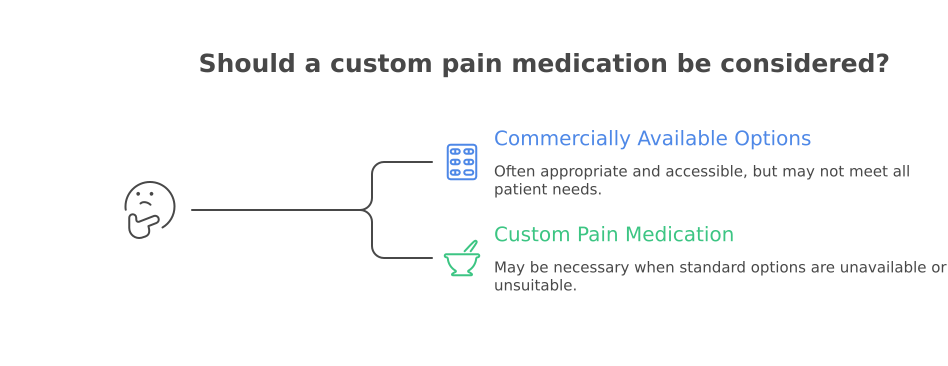
Most patients begin pain treatment with commercially available medications and non-drug approaches.
These established options are often appropriate, accessible, and supported by product-specific evidence. However, they do not meet every patient’s needs.
A healthcare professional may consider custom pain medication in BC when a clinically appropriate medication is unavailable in the required strength or dosage form.
Compounding may also be discussed when a patient cannot use certain ingredients found in a standard product.
Possible reasons for considering a customized topical preparation include:
- A commercially available topical product is unavailable.
- The available strength does not meet the prescribed requirement.
- The patient has difficulty swallowing tablets or capsules.
- Oral treatment has produced unacceptable side effects.
- A prescriber wants medication applied to a defined area.
- The patient has a confirmed sensitivity to a selected non-medicinal ingredient.
- A different cream, gel, or ointment base is required.
- The treatment plan requires an individualized dosage form.
These situations do not automatically mean that a compounded cream is the right choice. The healthcare provider must first consider the diagnosis, evidence for the proposed ingredients, previous treatment response, medication interactions, and potential risks.
How Does a Compounded Cream for Nerve Pain Work?
Nerve pain, also called neuropathic pain, develops when nerves or the systems that process nerve signals are damaged or functioning abnormally. It may feel different from the soreness associated with an overworked muscle or inflamed joint.
People often describe nerve pain as:
- Burning
- Electric
- Shooting
- Stabbing
- Tingling
- Pins and needles
- Numbness combined with pain
- Pain caused by light touch
- Unusual sensitivity to temperature
A compounded cream for nerve pain may contain one or more prescription ingredients selected to act on specific pain pathways. The intended goal may be to affect pain signalling at or near the application area.
Do You Need a Prescription for Customized Pain Relief Cream in Surrey?
A customized pain relief cream in Surrey will generally require a valid prescription when it contains prescription-only medicinal ingredients. The exact requirement depends on the ingredients, concentration, intended use, and applicable federal and provincial rules.
Health Canada maintains a Prescription Drug List identifying medicinal ingredients that require practitioner oversight when included in a drug. A compounded cream containing one or more of these ingredients cannot simply be selected from a pharmacy shelf like an over-the-counter muscle rub.
The prescription establishes an individualized treatment relationship between:
- The patient
- The authorized prescriber
- The compounding pharmacist
The prescriber assesses the patient’s condition and determines whether a customized topical dosage form is clinically appropriate. The pharmacist then reviews the prescription and determines whether the requested preparation can be compounded safely and accurately.
A patient should not attempt to select prescription ingredients or concentrations independently. Even when two people experience similar symptoms, their diagnoses, medical histories, medications, allergies, and treatment risks may differ.
Why Is a Patient-Specific Prescription Important?
Compounding is intended to address an identifiable patient need. It should not be used to produce large quantities of an unapproved formula for general sale or to bypass the availability of a suitable manufactured medication.
According to Health Canada’s Policy on Manufacturing and Compounding Drug Products in Canada, compounding may involve combining ingredients, altering the strength or dosage form of an existing product, or reformulating medication to permit a different method of delivery. The policy also distinguishes legitimate patient-focused compounding from drug manufacturing.
A patient-specific prescription allows the healthcare team to document:
- Why a standard manufactured medication may be unsuitable
- Which medicinal ingredients are required
- The concentration of each ingredient
- The intended dosage form
- The amount to apply
- The treatment area
- The application frequency
- The quantity to prepare
- The number of authorized refills
This information helps reduce ambiguity and allows the pharmacist to evaluate whether the formula is technically feasible.
How to Use Prescription Topical Pain Cream Safely
A prescription cream should be used only by the person named on the label and only for the condition and treatment area discussed with the healthcare team.
Apply Only the Prescribed Amount
Using extra cream does not guarantee greater pain relief. It may increase:
- Skin irritation
- Medication absorption
- Dizziness or drowsiness
- Drug interactions
- The risk of accidental transfer
- The chance of running out before the next refill
Patients should use the measuring method recommended by the pharmacist. Depending on the packaging, this may involve a calibrated pump, applicator, measuring device, or clearly defined quantity.
Apply It Only to the Instructed Area
Unless specifically directed by the prescriber or pharmacist, avoid applying a compounded pain cream to:
- Open wounds
- Cuts or abrasions
- Infected skin
- Severe rashes
- Recently shaved or irritated skin
- Eyes or eyelids
- Inside the mouth or nose
- Genital areas
- A different body part from the prescribed location
Do Not Use Heat Without Professional Instructions
Heating pads, electric blankets, hot-water bottles, saunas, and tight coverings may change medication absorption.
The patient should not cover the application site with an airtight dressing unless instructed. Occlusion can trap moisture and heat, which may alter how the formula behaves on the skin.
Avoid Mixing It With Other Topical Products
Using another cream, lotion, oil, sunscreen, or medicated product over the same area may:
- Dilute the prescription
- Change drug penetration
- Increase irritation
- Cause an interaction
- Affect how the base spreads or dries
Speak With a Pain Management Compounding Pharmacy in Surrey
Patients should not have to navigate a customized prescription without professional guidance. A pain management compounding pharmacy can review the prescribed formula, check potential medication concerns, explain how the cream should be applied, and answer questions about preparation time and cost.
Prosper Pharmacy24 provides compounding services for patients in Surrey and surrounding Lower Mainland communities. Depending on the prescription and individual need, the pharmacy may be able to prepare customized creams, gels, ointments, or other appropriate dosage forms.
Before the medication is prepared, the pharmacist may review:
- The complete prescription
- Current medications
- Allergies and sensitivities
- Previous topical reactions
- The proposed treatment area
- Ingredient compatibility
- The compounding base
- Storage requirements
- Application instructions
- Insurance and payment considerations
Learn more about compounding pharmacy services in Surrey or contact Prosper Pharmacy24 to discuss a prescription.
FAQs
What is a customized pain relief cream?
A customized pain relief cream is a patient-specific topical medication prepared by a compounding pharmacy. The ingredients, strength, base, and directions may be adjusted according to a prescription and the patient’s individual needs.
How is a compounded pain relief cream different from a regular cream?
A regular cream has a fixed formula made for general use. A compounded pain relief cream in Surrey is prepared for one patient and may use a customized strength, dosage form, or base when a standard product is not suitable.
Can a compounded cream help with nerve pain?
A compounded cream for nerve pain may be considered for localized burning, tingling, shooting, or sensitive nerve-related pain. Results vary, so the cause of the pain should be assessed and the formula should be selected by a prescriber and pharmacist.
Do I need a prescription for customized pain relief cream in BC?
A prescription is generally required when the cream contains prescription-only ingredients. The pharmacist reviews the formula, dosage, safety, and application instructions before preparing the custom pain medication in BC.
How does a pain management compounding pharmacy prepare the cream?
The pharmacist reviews the prescription, checks the ingredients for compatibility, selects a suitable base, and prepares the medication using professional compounding standards. The final product is labelled with patient-specific directions, storage information, and a beyond-use date.
Is a personalized topical cream safer than oral pain medication?
Not always. A personalized topical cream may reduce direct exposure of the stomach to a medication, but some ingredients can still enter the bloodstream and cause side effects or interactions.
How long does customized pain relief cream take to work?
The timing depends on the ingredients, strength, pain type, treatment area, and individual response. Ask the pharmacist or prescriber when to expect an initial effect and when the treatment should be reviewed.
Can I apply compounded pain cream to broken or irritated skin?
Do not apply it to broken, infected, or irritated skin unless a healthcare professional specifically tells you to do so. Damaged skin may absorb medication differently and increase the risk of irritation or side effects.
Is compounded pain medication covered by insurance in BC?
Coverage varies by insurance plan, ingredients, compounding fees, and whether a commercial alternative is available. Patients should ask the pharmacy for an estimate and confirm coverage with their insurer before the medication is prepared.
Where can I find customized pain relief cream in Surrey?
Patients searching for a prescription pain cream near me can contact a licensed compounding pharmacy for chronic pain in Surrey, BC. The pharmacy can review the prescription, confirm ingredient availability, explain the cost, and provide counselling on safe use.
Conclusion
A customized pain relief cream in Surrey may provide a personalized dosage-form option when a standard commercial medication does not adequately meet a patient’s clinical needs. The formulation may be adjusted according to the prescription, treatment area, medication history, allergies, and intended goals.
Customization, however, does not guarantee better pain relief. The potential value of a compounded cream depends on the diagnosis, medicinal ingredients, concentration, base, application technique, available evidence, and individual response.
Patients considering customized pain relief creamin Surrey, BC should begin with an appropriate medical assessment. A prescriber and compounding pharmacist can then determine whether a patient-specific topical preparation has a reasonable role within the overall pain-management plan.
When it is properly prescribed, carefully prepared, and used according to professional instructions, a customized pain relief cream in surrey may offer a practical option for selected patients. Regular follow-up remains important to evaluate both effectiveness and safety.
To discuss whether a customized pain relief cream in surrey may be suitable for your prescription needs, contact Prosper Pharmacy24 in Surrey, BC. A pharmacist can review the prescription, explain the compounding process, discuss expected preparation time and cost, and provide guidance on safe application. You can book an appointment online or contact Prosper Pharmacy24 for more information.
About the Health Experts Meet the team behind this article

Written by: Prosper Pharmacy24 editorial team
The editorial team prepares general health and pharmacy-related content to help readers better understand topics such as medications, vaccinations, travel health, and everyday pharmacy care. Our content is developed with a patient-friendly approach and is intended for educational purposes only.

Medically reviewed by - Dr. Anant Mrar, R.Ph.
He is a registered pharmacist in British Columbia. He provides professional input on selected health content to help ensure the information is clear, practical, and consistent with commonly available pharmacy and public health guidance at the time of publication. This content is for general education and should not replace personalized advice from a pharmacist, physician, or other healthcare professional.